
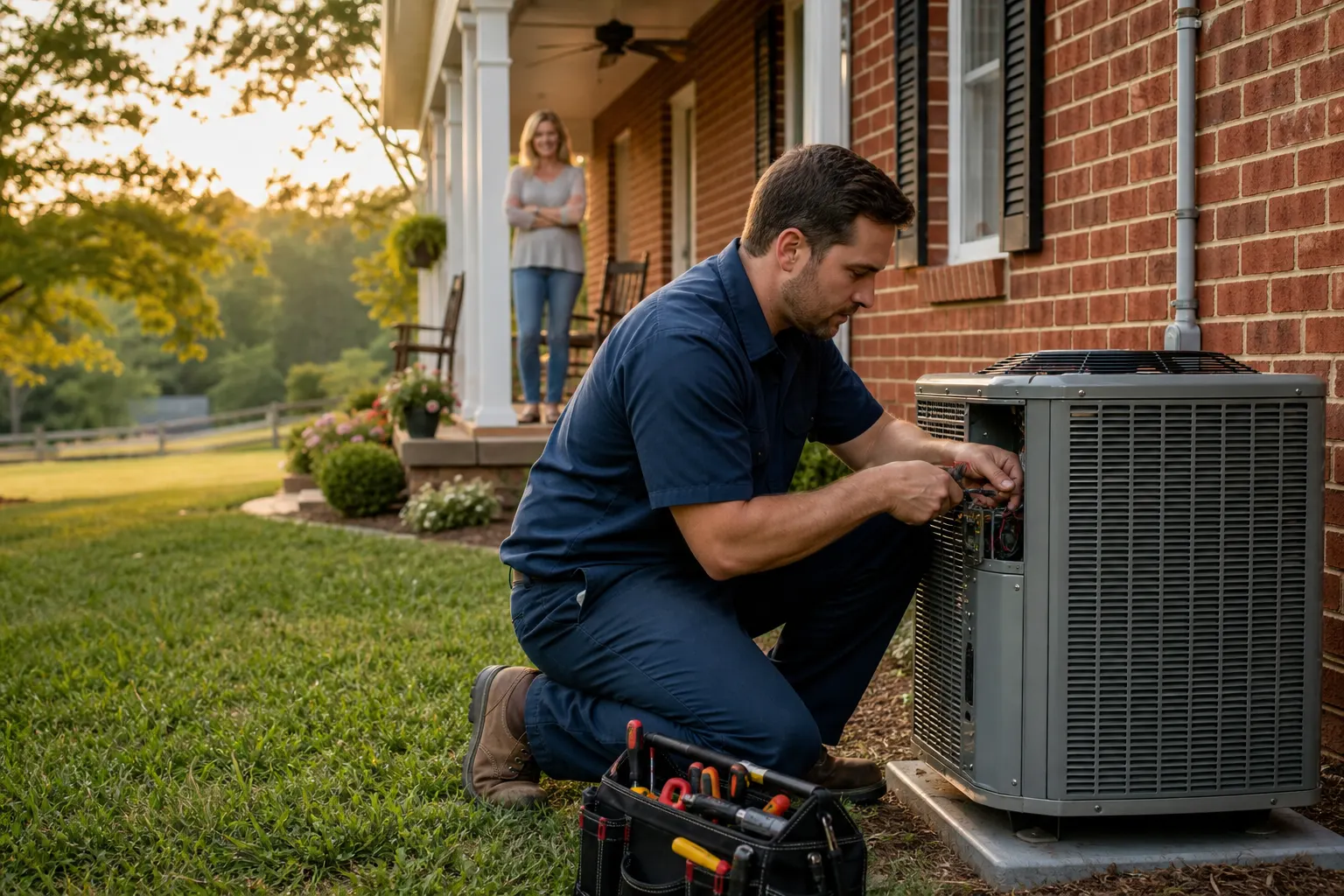
Replacing Failing Commercial HVAC Systems in Burgin Facilities
Are you constantly fielding complaints from employees about hot and cold spots in the building, or watching your utility bills skyrocket while your aging rooftop unit struggles to keep the humidity out of your facility? Sinking money into band-aid fixes for a commercial system that is fifteen years old is a losing battle that eventually leads to sudden, catastrophic breakdowns. You need a long-term, reliable solution designed for your building's specific footprint, and Feistritzer Heating & Air Conditioning provides honest, brand-agnostic assessments to determine exactly what your business needs to restore reliable climate control.
Signs It Is Time for a Commercial HVAC Replacement
Escalating Commercial Energy Costs
You notice a steady, month-over-month increase in your facility’s gas or electric bills, even when the weather has not drastically changed and your operating hours remain the same. This indicates that your commercial HVAC system has lost its efficiency and is working much harder than it should. The internal motors, compressors, and coils are degrading, forcing the unit to run longer and draw significantly more amperage just to maintain the thermostat setting.
If ignored, you are not just overpaying the utility company every month. You are pushing the system toward total mechanical failure by forcing compromised parts to carry the entire heating and cooling load. That wasted capital could be funding a high-efficiency replacement that actually lowers your overhead and improves your bottom line.
Severe Temperature Inconsistencies Across Zones
One side of your office or retail space is freezing, while the other side is stiflingly hot. Employees are using space heaters in the winter or desk fans in the summer just to stay comfortable at their workstations. While sometimes a ductwork issue, in older units, this usually means the blower motor is failing and can no longer generate the static pressure required to push air through the entire building.
It can also mean the system is improperly sized for the space, failing to deliver conditioned air to the furthest registers. Allowing this to continue destroys workplace productivity and creates a miserable environment for your customers. It also causes the unit to run continuously as the thermostat in the warm zone never actually gets satisfied.
Persistent Indoor Humidity and Odors
The air inside your business feels heavy, sticky, or smells musty, particularly during the humid months. You might even notice condensation on windows, a clammy feeling on surfaces, or paper products feeling damp to the touch. Your commercial air conditioner is responsible for dehumidifying the space just as much as it is responsible for cooling it.
When a unit is too large for the space, it cools the air too quickly and shuts off without running long enough to pull the moisture out of the environment. High humidity is disastrous for commercial spaces, especially given the localized moisture from nearby Herrington Lake. It encourages mold growth in your ductwork, damages sensitive electronics, ruins inventory, and creates an unhealthy environment that can lead to liability issues.
Frequent and Expensive Repair Callouts
You have a commercial HVAC technician on speed dial and feel like you are constantly approving invoices for minor fixes. You are paying for a new contactor one month, a refrigerant recharge the next, and a blower belt the month after that. The system has reached the end of its functional lifespan, and the components are failing in a rapid domino effect.
This cascading failure is incredibly common in commercial units over a decade old that have been exposed to the harsh elements on a rooftop. Continuing to repair a dying system is throwing good money after bad. Eventually, a major component like the compressor will fail completely, leaving you with no heating or cooling and the urgent need for a rushed replacement.
What Causes Commercial HVAC Systems to Fail
End of Useful Equipment Lifespan
Most commercial rooftop units and heavy-duty split systems are engineered to last fifteen to twenty years with proper care. Once they cross this threshold, the internal components simply wear out from thousands of hours of continuous operation. The metal fatigues, electrical connections degrade, and the heat exchangers endure extreme thermal stress that eventually leads to cracking.
In the historic brick buildings around Burgin, we frequently see systems that were installed decades ago during a retrofit. These aging units are now drastically outmatched by modern efficiency standards and are physically deteriorating beyond the point of reasonable repair. The solution involves a complete system replacement to restore safety and efficiency to your property.
Incorrect Tonnage and Load Mismatch
Many failing systems were either undersized to save money during the initial build or oversized under the false assumption that a larger unit would perform better. Local businesses often change hands, and a space that was once a low-heat-load warehouse might now be a high-heat-load restaurant or a crowded office. If the HVAC system was never updated to match the new business operations, it will fail prematurely.
An undersized unit will run constantly, burning out the compressor as it struggles to reach the set temperature. An oversized unit will short-cycle, turning on and off rapidly, which destroys the electrical components and fails to remove humidity. We perform comprehensive commercial load calculations to ensure your new system matches your current operational needs perfectly.
Severe Coil Degradation and Neglect
The condenser and evaporator coils have become heavily corroded, compacted with dirt, or physically damaged, preventing the vital transfer of heat. Because commercial units are often located on rooftops or behind buildings, they are highly susceptible to pulling in dust, pollen, and debris from the surrounding agricultural areas. Without strict, regular maintenance, this debris chokes the system and forces the compressor to overheat.
When coils are severely degraded, the system cannot absorb heat from inside the building or release it outside. Depending on the extent of the damage and the age of the unit, replacing the coils might not be cost-effective. In these cases, replacing the entire system is the only way to restore proper airflow and heat transfer.
Compromised Ductwork and Air Distribution
Sometimes the failure is not just in the rooftop unit, but in the delivery system itself. Decades-old commercial ductwork can develop massive leaks, lose its interior insulation, or become disconnected above the drop ceiling. When this happens, your expensive conditioned air is being pumped into the attic or plenum space instead of your actual workspace.
This forces the HVAC unit to work double-time to compensate for the lost air, accelerating the wear and tear on the blower motor and compressor. During a replacement assessment, we evaluate the integrity of your ductwork to ensure your new equipment is not hooked up to a failing distribution system.
What to Expect During Your Commercial HVAC Assessment
A Repair-First Diagnostic Approach
When we arrive at your business, we do not just look at the brand name on the box and immediately quote you a replica. We act as your consultative partner and start by diagnosing the entire system to ensure a full replacement is actually necessary. We evaluate the electrical components, test the static pressure, and inspect the heat exchanger for safety hazards.
If a repair makes financial sense and will provide reliable operation, we will tell you. However, if the system is unsafe, highly inefficient, or facing a catastrophic compressor failure, we will explain exactly why replacement is the most responsible business decision. We show you the data so you can make an informed choice for your facility.
Comprehensive Load Calculations
If a replacement is the right operational move, we conduct a full engineering assessment of your property. We evaluate your building's square footage, insulation quality, window placement, and daily occupancy levels. We also factor in the heat generated by your specific business equipment, whether that includes commercial ovens, heavy machinery, or a room full of computers.
This data allows us to perform a precise load calculation to determine the exact tonnage your building requires. We never guess or simply swap out a unit based on the old equipment's data plate. Getting the sizing right is the single most important factor in the longevity and efficiency of your new commercial installation.
Brand-Agnostic System Selection
Because we are completely brand-agnostic, we present you with replacement options based on what will provide the best lifecycle, comfort, and efficiency for your specific building. We do not push a specific logo to meet a manufacturer quota. We explain the efficiency ratings, the warranty terms, and exactly how the new technology will improve your indoor air quality.
We also outline the installation timeline and exactly how we will stage the work. We coordinate crane lifts, electrical upgrades, and structural modifications to minimize disruption to your daily operations, employees, and customers. Our goal is to execute a seamless transition from your failing system to your new climate control solution.
Comprehensive Climate Solutions for Your Business
As a repair-first company, we will always evaluate if a thorough Commercial HVAC Repair & Service can safely and economically extend the life of your current equipment before recommending a full replacement. If we do proceed with a new installation, we highly recommend protecting that capital investment by enrolling in our Commercial HVAC Maintenance & Tune-Up program. Routine professional maintenance is the only way to ensure your new system runs at peak efficiency, maintains its commercial warranty, and delivers reliable comfort for decades to come.
The True Cost of Delaying Commercial HVAC Replacement
Protecting Your Daily Operations
Waiting for your commercial system to fail completely is the most expensive way to manage your facility. When an HVAC unit dies in the middle of a severe weather event, you face immediate business interruption that directly impacts your revenue. You may have to send employees home, close your doors to customers, or risk losing temperature-sensitive inventory and vital IT equipment.
Furthermore, emergency replacements often mean you have to settle for whatever commercial equipment happens to be locally in stock right that second. You lose the ability to plan, budget, and select the optimal, high-efficiency system for your building's long-term needs. Rushed installations also require emergency crane scheduling and expedited shipping fees, significantly driving up your capital expenditure.
Taking Control of Your Overhead
By proactively replacing a failing system before it dies, you control the timeline and protect your revenue stream. You can schedule the installation during off-hours or slower business days to ensure zero disruption to your customer experience. More importantly, you immediately start recouping your investment through significantly lower monthly utility bills and the elimination of constant repair invoices.
Modern commercial HVAC systems offer incredible advancements in variable-speed technology and humidity control. Upgrading your equipment transforms your facility from a drafty, uncomfortable space into a precisely controlled environment. This improves employee morale, protects your physical assets, and creates a welcoming atmosphere that keeps your customers coming back.
Securing Reliable Climate Control for Your Business
Do not let a deteriorating HVAC system dictate your business operations or drain your operating budget through massive utility bills and constant repairs. Whether you manage a retail storefront, a historic office space, or an industrial facility in Burgin, you need a climate control system that works as hard as you do. Feistritzer Heating & Air Conditioning is ready to provide the honest, accountable, and expert commercial installation services your business deserves.