
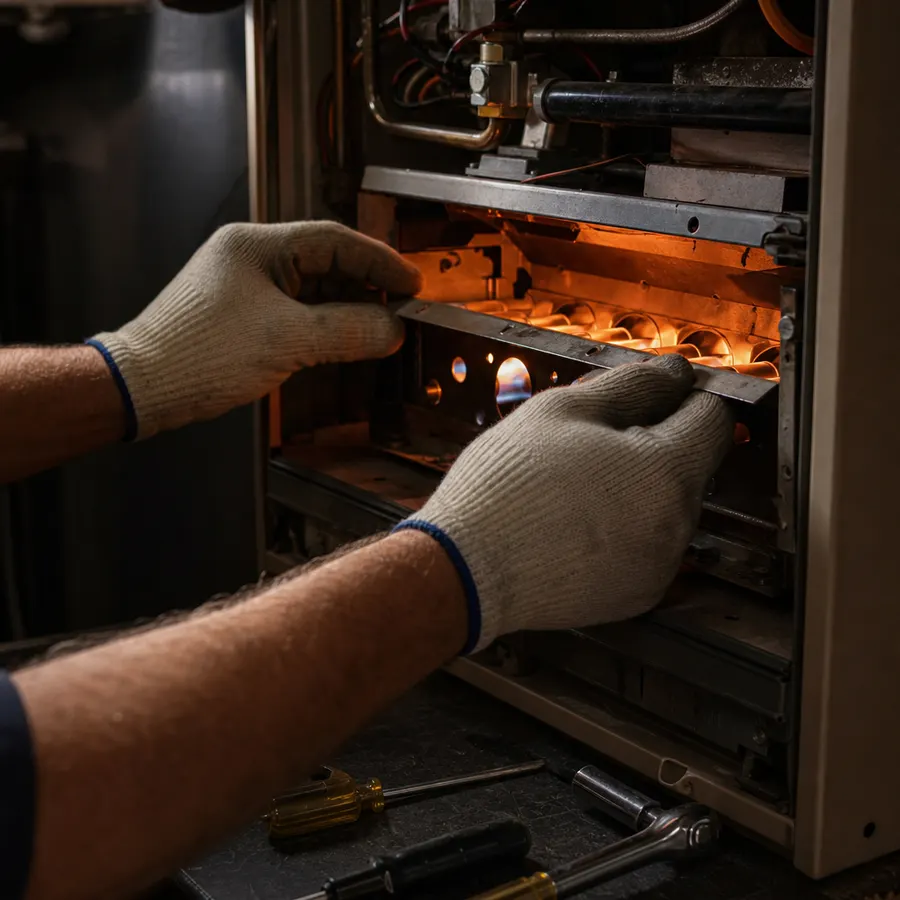
Resolving Heating Failures and Cold Spots in Your Lawrenceburg Home
Are you dealing with a furnace that blows lukewarm air, a heat pump that never seems to shut off, or specific rooms in your house that stay stubbornly cold no matter what the thermostat says? When your heating equipment runs constantly or fails to push warm air through the vents, it is a clear sign of a failing component that is actively driving up your utility bills and stressing the entire system. Feistritzer Heating & Air Conditioning is ready to diagnose the exact point of failure and provide a repair-first solution to get your heat running properly again.
Signs Your Heating System Needs Professional Repair
The System Runs Constantly but the House Feels Cold
You might notice your thermostat is set to 70 degrees, but the house stays stuck at 65 while the vents blow air that feels barely warm. The unit never actually cycles off to give the equipment a rest, which means your system has lost its heating capacity. In gas furnaces, this points to a failing gas valve or a dirty flame sensor preventing proper ignition.
In heat pumps, constant running often means the system is locked out of its primary mode and relying entirely on expensive auxiliary heat. This puts massive wear on your blower motor and forces the equipment to work overtime. Ultimately, this drives your utility bills through the roof while shortening the lifespan of your system.
Sudden, Unexplained Spikes in Utility Bills
You open your energy bill and realize it has doubled from one month to the next, even though your thermostat habits have not changed at all. This financial shock is often the very first sign that a heat pump or furnace is quietly struggling. When this happens, your equipment's efficiency has completely tanked, and the system is working twice as hard to produce the same amount of heat.
We frequently trace this back to severe airflow restriction, a failing motor, or leaky ductwork pulling unconditioned air from your attic or crawlspace. You end up paying for the cost of a repair in wasted energy anyway. Fixing the root cause restores your system's efficiency and stops the financial bleed immediately.
Loud Banging, Squealing, or Rattling Noises
You might hear a loud boom when the furnace turns on, a high-pitched squeal while it runs, or a metallic rattling sound near the indoor unit. Heating systems should operate relatively quietly, so any new or aggressive noise is a mechanical cry for help. A boom usually indicates delayed ignition, which means gas is building up inside the chamber before finally lighting.
A squeal is typically a failing blower motor bearing or a worn-out belt, while rattling often points to a blower wheel that has fallen out of balance. Delayed ignition is particularly dangerous because it can crack a heat exchanger over time and create a major safety hazard. Failing bearings will eventually cause the motor to seize entirely, turning a minor repair into an expensive replacement.
Distinct Cold Spots and Weak Airflow
Your living room might feel perfectly warm, but the back bedrooms are freezing, and there is very little air coming out of the vents in those specific rooms. This is a very common issue in Lawrenceburg homes with older, retrofitted ductwork. While this can sometimes be an issue with the ductwork itself, it frequently points to a failing blower motor.
The motor simply no longer has the power required to push conditioned air to the furthest reaches of the house. Ignoring weak airflow forces the system to run longer cycles to compensate for the temperature difference. This accelerates wear and tear on the entire unit while leaving your family completely uncomfortable.
What’s Actually Causing Your Heating Problems?
Clogged Filters and Airflow Restrictions
Your heating system is essentially suffocating because air cannot move freely through the equipment. When airflow stops, the heat exchanger overheats rapidly, triggering the high-limit switch to shut the burners down to prevent a fire hazard. In rural and agricultural parts of Anderson County, we see systems pull in high amounts of dust, pollen, and debris.
If filters are not changed frequently, this particulate buildup quickly chokes the blower and evaporator coil. Resolving this involves replacing the filter, thoroughly cleaning the blower wheel, and resetting the safety limits. We also perform a careful inspection to ensure the heat exchanger was not damaged by the repeated overheating cycles.
Failing Ignition Systems and Flame Sensors
Your thermostat calls for heat, but the furnace either refuses to light or lights for three seconds and immediately shuts right back off. This is very common in the older gas furnaces found throughout Lawrenceburg's established neighborhoods. Over time, flame sensors build up stubborn carbon deposits and fail to read the flame accurately.
When the sensor cannot detect the fire, the control board shuts the entire system down as a built-in safety precaution. Fixing this issue requires cleaning or replacing the flame sensor and testing the hot surface ignitor. We also verify that the gas valve is opening at the correct pressure to ensure reliable, safe ignition moving forward.
Degraded Blower Motors from High-Cycle Usage
The motor responsible for pushing conditioned air through your home is drawing too many amps, overheating, or has completely seized up. The rapid temperature swings in Central Kentucky mean systems are forced to cycle on and off constantly. This constant starting and stopping puts incredibly heavy wear on blower motor capacitors and internal bearings.
Eventually, the components degrade to the point where the motor simply cannot spin. We diagnose this by testing the exact electrical draw of the motor. Often, we can restore function just by replacing a weak capacitor, but if the motor itself has failed, we replace it with an appropriate match based on your budget and system age.
Thermostat and Communication Failures
The brain of your heating system is simply no longer talking to the mechanical equipment. You might hear the thermostat click on the wall, but nothing actually happens at the furnace or heat pump. We frequently see this when outdated wiring finally degrades or when a homeowner tries to install a modern smart thermostat without a proper common wire.
Without that solid communication line, the equipment does not know when to turn on. We fix this by tracing the low-voltage wiring from the wall to the equipment and testing the main control board. From there, we can either repair the broken connection or install a proper control system that communicates flawlessly.
What to Expect During Your Heating Diagnostic
When you call us for Heating Repair & Service, you get a consultative, repair-first approach rather than a high-pressure sales pitch. We do not just walk into your home, look at a broken part, and immediately try to sell you a brand-new system. Our NATE-certified technicians perform a comprehensive, whole-system diagnostic to find the true root cause of the failure.
We check the airflow, test the electrical components, verify the safety limits, and inspect the ductwork. Because we are proudly brand-agnostic, we have the expertise to service all makes and models of heating equipment.
A Consultative Approach to HVAC Repair
After the diagnostic is complete, we sit down with you to explain exactly what we found in plain language. We show you what can be repaired today, what might need attention later, and what makes the most financial sense for your specific situation.
We evaluate everything by load, comfort, and the lifecycle of your equipment. Feistritzer Heating & Air Conditioning believes in treating your home exactly how we would treat our own.
Comprehensive HVAC Support for Your Home
Many sudden heating failures can be prevented entirely with proactive, professional care. We highly recommend scheduling a Heating Maintenance & Tune-Up to catch failing capacitors and dirty flame sensors long before they cause a midnight breakdown.
Heat Pump and Dual-Fuel Expertise
Additionally, since many homes in the area rely heavily on electric heating, our technicians are highly trained in Heat Pump Repair & Service. This ensures that your dual-fuel and heat pump systems operate efficiently without forcing you to rely on expensive emergency heat settings.
The Real Cost of Delaying Heating Repairs
Ignoring a struggling heating system is never a good strategy, as minor symptoms quickly snowball into major mechanical failures. A furnace that is short-cycling or making loud booming noises could have a cracked heat exchanger or a delayed ignition problem. These specific issues present a severe safety risk, including the potential for carbon monoxide to leak directly into your living space.
Beyond safety, an HVAC system operates as a tightly integrated closed loop. When one part struggles, the rest of the system has to work harder to compensate.
Small Problems Cause Expensive Damage
If a twenty-dollar capacitor is failing and you ignore it, the electrical strain will eventually burn out a six-hundred-dollar blower motor. Treating the small problem immediately saves the most expensive components in your system from premature death.
A struggling system also consumes significantly more gas or electricity just to maintain a baseline temperature. The money you think you are saving by delaying a service call is quickly lost to spiked utility bills.
Restoring Comfort and Reliability to Your Heating System
We have been serving Central Kentucky since 1976 by doing things right the first time and standing behind our work. Our homegrown, accountable approach means you get honest answers and reliable repairs that actually last. Stop paying high utility bills for a house that still feels cold, and contact Feistritzer Heating & Air Conditioning today to schedule your diagnostic visit and get your Lawrenceburg heating system back to peak performance.