
Solving Complete Heating System Failures in Richmond Homes
Are you constantly nudging the thermostat up because certain rooms never seem to get warm, or is your furnace running non-stop but only blowing lukewarm air while your utility bill doubles? When a heating system loses its capacity to heat, it doesn't just stop working—it starts actively wasting your money through severe mechanical degradation, and in the case of gas systems, could be harboring a cracked heat exchanger that poses a serious carbon monoxide risk. The NATE-certified technicians at Feistritzer Heating & Air Conditioning are ready to evaluate your system, give you the honest truth about its condition, and outline your best options.
Warning Signs It Is Time for a Heating Replacement
Skyrocketing Energy Bills Without the Comfort
You notice your monthly utility bills creeping up—or suddenly spiking—even though you haven't changed your thermostat settings. The house still feels chilly, but you are paying more than ever just to try and heat it. This frustrating scenario is one of the most common signs that your equipment is failing.
This usually indicates that your heating system has lost its mechanical efficiency. Heat pumps may be stuck relying on expensive electric resistance heating, often called emergency heat, because the compressor can no longer do its job. Alternatively, an aging furnace might be burning excess fuel just to maintain a baseline temperature in the home.
Ignoring this symptom means you are essentially paying for a new heating system in wasted utility costs without getting any of the benefits. When the cost to operate the unit becomes completely disconnected from the comfort it provides, replacement is usually the smartest financial move.
Yellow Burner Flames or Soot Accumulation
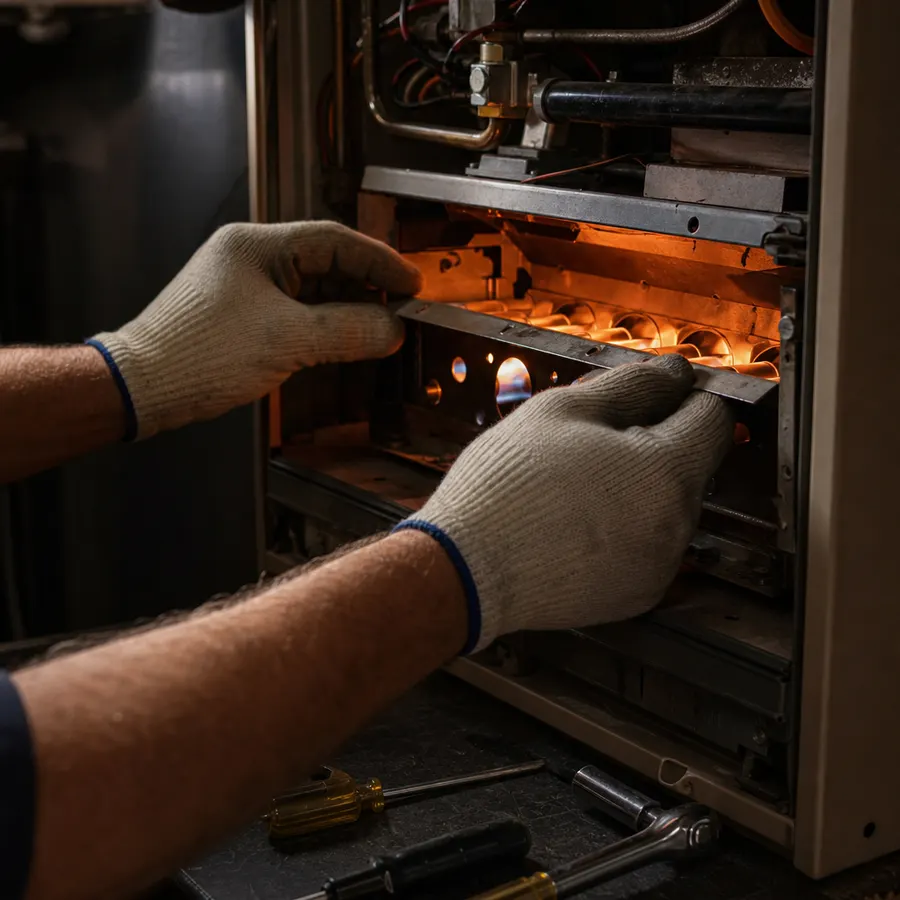
When looking at your gas furnace, you see a flickering yellow or orange flame instead of a crisp, steady blue one. You might also notice black soot gathering around the registers, the furnace cabinet, or near the exhaust vent. These visual cues mean the system is no longer burning fuel cleanly.
A yellow flame indicates incomplete combustion, which is often caused by a dirty burner or, more seriously, a cracked heat exchanger. It means the system is struggling to process fuel safely. This is an immediate safety hazard that requires professional intervention right away.
Incomplete combustion produces carbon monoxide, a dangerous, odorless gas that can leak into your home's air supply if the heat exchanger is compromised. If you see yellow flames or soot, you need to have the system evaluated immediately to protect your household.
The System Runs Constantly but Blows Lukewarm Air
You hear the system turn on and stay on for hours, but when you put your hand over the vent, the air coming out is barely warm. The equipment is working overtime, but the temperature inside the house never actually reaches what you set on the thermostat. This constant running puts massive strain on every moving part.
For heat pumps, this often points to a failing compressor or a severe refrigerant leak that has robbed the system of its ability to transfer heat. For gas furnaces, it could mean a failing blower motor or a compromised heat exchanger that cannot distribute warmth properly.
A system running continuously will quickly burn out its remaining functional components. This chain reaction turns what might have been an isolated, repairable issue into a mandatory full replacement as multiple parts fail simultaneously.
Frequent Breakdowns and Band-Aid Repairs
You have had a technician out to fix the heating system two or three times in the last couple of years. You find yourself constantly waiting for the next part to fail, feeling anxious every time the temperature drops outside. Equipment simply reaches the end of its mechanical lifespan eventually.
When core components like the blower motor, control board, and heat exchanger start failing back-to-back, the system is in active decline. Continuing to patch a dying system is a poor investment that only delays the inevitable.
The money spent on constant repairs eventually exceeds the cost of a modern, reliable, and highly efficient replacement. Upgrading the system stops the bleeding and restores your peace of mind during the coldest months.
What Is Causing Your Heating System to Fail
Cracked Heat Exchangers from Thermal Fatigue
The heat exchanger is the vital metal shield that separates the toxic combustion process from the clean air you breathe inside your home. Over time, the constant heating up and cooling down causes the metal to stress, warp, and eventually crack. This is a natural consequence of years of heavy operation.
Central Kentucky's rapid temperature fluctuations put massive thermal stress on older furnaces. In historic Richmond properties, we frequently find aging furnaces where the heat exchanger has finally surrendered to decades of expansion and contraction. Once this metal barrier fails, the entire system is compromised.
A cracked heat exchanger cannot be safely repaired with a patch or a weld; it must be completely replaced. Given the high cost of the replacement part and the extensive labor involved in dismantling the furnace to install it, replacing the entire heating unit is almost always the most financially sound and safe solution.
Improperly Sized Original Equipment
Your heating system has always struggled to keep the house comfortable, either cycling on and off rapidly or running endlessly without reaching the set temperature. This is a classic symptom of a unit that was never the right size for the home to begin with.
Many of the ten-to-fifteen-year-old subdivisions around Richmond were built with builder-grade units that were selected based on upfront cost rather than proper load calculations. Oversized units short-cycle, which means they turn on and off so frequently that the motors wear out prematurely. Undersized units, on the other hand, run themselves to death trying to heat a space that is simply too large for their capacity.
The solution involves performing a meticulous load calculation to install a brand-agnostic system perfectly sized for your specific property. We factor in your home's exact square footage, insulation levels, and window placement to ensure your new equipment runs at peak efficiency.
Compressor Failure from Refrigerant Leaks
The heat pump suddenly loses its ability to pull heat from the outside air, forcing the system to rely entirely on those expensive auxiliary heating strips. Years of vibration and mechanical wear can cause microscopic leaks to form in the copper refrigerant lines.
When a heat pump runs low on refrigerant, it has to work twice as hard to achieve the same result. This causes the compressor to overheat, struggle, and eventually seize up completely. If the heat pump is older and uses phased-out, expensive refrigerant, replacing just the compressor is often cost-prohibitive.
A full heating installation and replacement restores proper heating capacity and drastically lowers your monthly operating costs. It also upgrades your home to modern, environmentally friendly refrigerants that are far easier to service in the future.
Years of Deferred Maintenance
The system has suffered a catastrophic failure due to severely restricted airflow, clogged indoor coils, or burnt-out blower motors. In areas with high rental density, heating systems often go years without routine filter changes or professional tune-ups.
This level of neglect forces the blower motor to work against heavy static pressure until it simply gives out. The lack of airflow also causes internal components to overheat, baking the electronics and stressing the heat exchanger. Once a severely neglected system suffers a major failure, a complete replacement is usually required to restore safe, reliable heating to the property.
When we install a new system, we ensure the ductwork is clear and the installation is commissioned properly. This guarantees the new unit starts its lifecycle off right, avoiding the pitfalls of restricted airflow from day one.
What to Expect During Your Heating Replacement Visit
When you call Feistritzer Heating & Air Conditioning to your home, you get a homegrown, consultative approach—not a high-pressure sales pitch. First, we are a repair-first company at our core. We will comprehensively diagnose your entire system to see if a safe, cost-effective repair is actually possible before ever recommending a replacement.
If your system is truly at the end of its lifecycle, or if a repair simply does not make financial sense given the age of the unit, we will show you exactly why. We believe in total transparency, walking you through the condition of your equipment so you understand exactly what is happening. If replacement is necessary, we do not just quote the same size box you currently have sitting in your basement or utility closet.
We perform detailed load calculations to determine the exact heating requirements of your specific home. Because we are completely brand-agnostic, we recommend the equipment we would put in our own homes based on your comfort needs, load requirements, and lifecycle value—not based on a manufacturer's logo.
Proper Commissioning for Long-Term Reliability
Finally, every installation we perform is fully commissioned before we leave your property. We test the static pressure, verify the airflow, and measure the temperature rise to ensure the new system performs exactly to the manufacturer's strict specifications.
This meticulous testing process guarantees that your new equipment will deliver the efficiency and comfort you paid for. It provides post-install accountability you can trust, ensuring your investment is protected for years to come.
Related Services You May Need
Because we believe in diagnosing the whole system, our technicians may find that a full replacement is not necessary just yet. In those cases, we provide comprehensive heating repair and service to get your current unit back online safely and efficiently. If you are upgrading your entire system, this is also the perfect time to look into thermostat and controls installation and replacement to maximize the energy efficiency of your brand-new equipment.
The True Cost of Delaying a Heating Replacement
Ignoring a failing heating system is a serious gamble with your daily comfort, your household budget, and your family's safety. Systems that are limping along consume significantly more electricity or gas to produce a fraction of the heat they used to. This means you are overpaying the utility company every single month just to stay mildly comfortable.
Furthermore, heating systems rarely fail on a mild, sunny afternoon when it is convenient to schedule a service call. They fail when they are working their hardest—typically during the coldest nights of the year. This leaves you scrambling for an emergency replacement to protect your home's plumbing from freezing and your family from severe cold.
Immediate Safety Concerns
The most critical reason to address a failing system is the potential for life-safety hazards. An aging gas furnace with a compromised heat exchanger is a severe carbon monoxide risk that cannot be ignored.
This is not just an efficiency issue or a matter of comfort; it is a dangerous situation. Replacing a condemned furnace immediately is the only way to ensure the air circulating through your home is safe to breathe.
Restoring Dependable Heat to Your Richmond Home
Do not wait until your system completely shuts down to find out what is wrong with it. Whether you need an honest second opinion on a condemned furnace or a meticulous, commissioned installation of a new heat pump, we are here to help. As a family-owned company serving Central Kentucky since 1976, Feistritzer Heating & Air Conditioning is ready to evaluate your system and provide the accountable, expert solutions you deserve.