
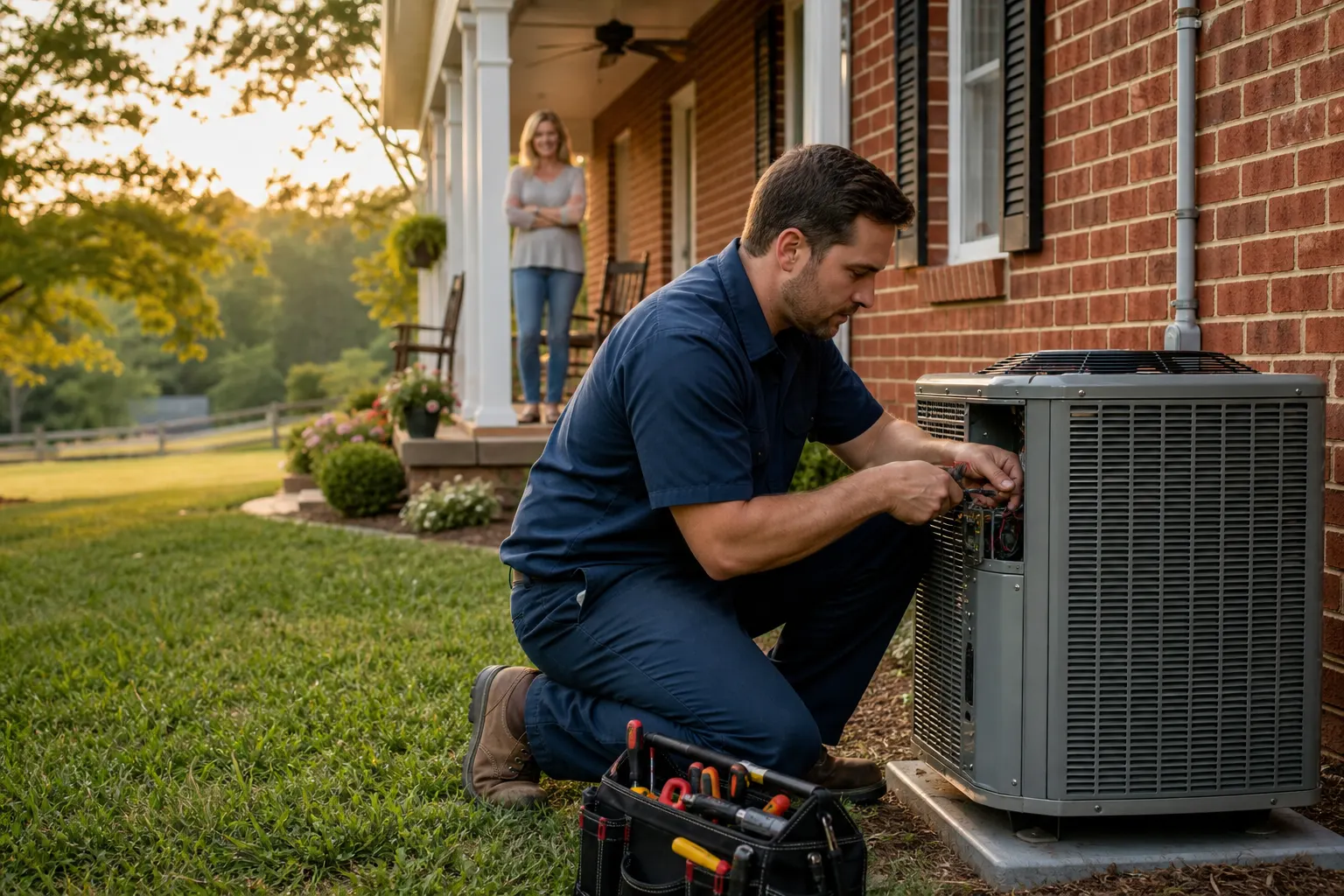
Addressing Commercial HVAC Performance Drops in Your Salvisa Facility
Are your facility's energy bills creeping up month over month while certain zones of your Salvisa building remain stubbornly uncomfortable, or have you noticed your rooftop unit running constantly just to maintain a baseline temperature? Commercial HVAC systems do not heal themselves, and ignoring these early warning signs inevitably leads to sudden equipment failure that puts your inventory, employee productivity, and customer comfort at immediate risk. Feistritzer Heating & Air Conditioning is ready to evaluate your equipment's true condition and provide straight answers on what needs attention now and what can wait.
Warning Signs Your Commercial HVAC System Needs a Professional Tune-Up
Unexplained Spikes in Operating Costs
You notice that your monthly electric or gas bills are noticeably higher than they were at the same time last year, even though your operating hours and thermostat settings have not changed. Nine times out of ten, this means your system has lost its operating efficiency and is pulling more amperage to do the same amount of work. Usually, the motors are straining against clogged filters or the coils are insulated by a layer of dirt that prevents proper heat transfer.
If ignored, this does not just eat into your profit margins through inflated utility bills. The sustained electrical strain will eventually burn out the compressor or blower motor. That leads to a much more expensive repair that could have easily been avoided with proactive care.
Inconsistent Temperatures Across Building Zones
Employees in the front office might be freezing, while the back warehouse or retail floor is sweltering. You might also notice weak airflow coming from the supply registers in specific areas of the building. This symptom points directly to airflow restriction or ductwork issues within your commercial space.
It could be failing dampers, a heavily soiled blower wheel, or low refrigerant levels causing the system to lose its capacity to condition the air fully before it reaches the furthest points of the building. Uneven temperatures lead to constant thermostat adjustments and employee complaints. It can also cause potential damage to temperature-sensitive inventory stored in unconditioned zones.
The System Runs Constantly
The HVAC unit never seems to shut off, running in one continuous loop, or it turns on and off rapidly in short bursts. When a system short-cycles, it is often a safety mechanism kicking in because a component is overheating or freezing up. Continuous running usually means the system is undersized for the current load, or it is so bogged down by neglected maintenance that it can no longer reach the set point on the thermostat.
Both scenarios put massive stress on the system's most expensive components. A system that runs constantly will reach the end of its mechanical lifecycle years before it should. Commercial equipment is built to handle heavy loads, but it still requires downtime to prevent mechanical exhaustion.
Strange Odors or Unusual Noises
You hear squealing, grinding, or clanking coming from the ceiling or outdoor unit, or you notice a persistent musty, dirty-sock smell blowing through the vents. Squealing usually indicates a slipping belt or failing bearings in the blower motor, while grinding means metal-on-metal friction. Musty odors typically indicate organic growth in a clogged condensate drain pan, or a pest intrusion inside the unit.
Mechanical noises precede mechanical failure, meaning a breakdown is imminent if the sound is ignored. Odors indicate poor indoor air quality that can become a health and safety liability for your staff and customers. Addressing these sensory warnings early saves you from dealing with a complete system shutdown.
What Causes Commercial HVAC Systems to Lose Efficiency?
Agricultural Dust and Debris on Condenser Coils
The delicate aluminum fins on your outdoor unit become completely impacted with dirt, preventing the system from releasing or absorbing heat. In a rural community like Salvisa, commercial equipment is heavily exposed to field dust, harvest debris, and high pollen counts. This agricultural particulate matter builds up on rooftop units and ground-level condensers much faster than it would in a paved urban center.
The solution requires a deep, chemical coil cleaning to restore proper airflow and heat transfer. We perform this service carefully to clear the blockage without bending or damaging the delicate fins. Clean coils allow the compressor to run cooler, extending its lifespan significantly.
Neglected Air Filters and Blower Assemblies
The system's air filters become entirely blocked, forcing the blower motor to work twice as hard to pull air through the system. Over time, the dirt bypasses the filter and coats the blower wheel itself. Because commercial systems often run continuously during business hours, filter degradation happens rapidly.
In environments with high foot traffic or nearby unpaved areas, standard filter changes are rarely sufficient. We replace the filters with the correct rating for your specific equipment load and clean the blower assembly to restore optimal airflow. This simple maintenance step drastically improves both efficiency and indoor air quality.
Electrical Component Wear and Tear
Contactors become pitted and burned, capacitors lose their ability to hold a charge, and electrical connections vibrate loose over thousands of operating hours. Rural power grids can sometimes experience minor voltage fluctuations. Combined with the heavy starting load of commercial compressors, this puts extra stress on these electrical components.
Proactive maintenance involves testing the microfarads of capacitors and inspecting contactors under load. We replace these inexpensive parts before they fail and prevent the compressor from turning on. Catching a weak electrical component early is the best way to prevent a catastrophic motor failure.
Pest Intrusions in Outdoor Cabinets
Mice, birds, or insects build nests inside the electrical compartments or duct runs of the HVAC system. They often chew through low-voltage wires or block exhaust flues. In agricultural areas, outdoor HVAC cabinets provide a warm, sheltered environment that is highly attractive to local wildlife.
We clear out any debris, repair compromised wiring, and ensure all cabinet panels and entry points are properly sealed. This helps prevent future intrusions from disrupting your business operations. Keeping the cabinet secure is vital for maintaining safe and reliable climate control.
What to Expect During Your Commercial Maintenance Visit
A Consultative, Whole-System Approach
When you call for commercial HVAC maintenance, we do not just change the filters and walk away. We take a consultative, whole-system approach to your facility's climate control. A NATE-certified technician will arrive at your building to conduct a comprehensive diagnostic of your heating and cooling equipment.
We check the amp draw on all motors, inspect the heat exchangers for micro-fractures, test the refrigerant charge, and deep-clean the critical components. Because Feistritzer Heating & Air Conditioning is a homegrown, brand-agnostic company, we are not here to push a specific manufacturer's logo. We evaluate your system based on load, comfort, and lifecycle.
Honest, Repair-First Recommendations
After the inspection, we walk you through our findings. We clearly explain what is operating perfectly, what needs immediate attention to prevent a breakdown, and what minor wear and tear can simply be monitored for now. You get accountable, repair-first advice that treats your business's bottom line with respect.
Comprehensive Commercial HVAC Solutions
Supporting Your Long-Term Climate Needs
During a routine tune-up, we sometimes uncover major components that have already failed or are beyond safe operation. If that happens, our Commercial HVAC Repair & Service team is equipped to handle complex fixes to get your business back online quickly.
Alternatively, if your aging system is becoming a continuous financial drain and repairs no longer make economic sense, we offer consultative Commercial HVAC Installation & Replacement. We will help you design a system that fits your building's exact load requirements and your long-term budget.
The Business Cost of Skipping Commercial HVAC Maintenance
The Risks of Operating with Restricted Airflow
Ignoring routine maintenance on commercial equipment is a gamble that rarely pays off. When HVAC systems run with restricted airflow or electrical strain, the cost of waiting compounds quickly. You leave your facility vulnerable to issues that go far beyond a simple lack of comfort.
A failing capacitor or a dirty coil can easily cause a compressor to overheat and die, leading to catastrophic equipment failure. If your system fails during peak operating hours, you risk having to close your doors or turn away customers due to unsafe indoor temperatures.
Protecting Your Inventory and Overhead
For businesses relying on climate control to protect sensitive goods, electronics, or agricultural products, a sudden loss of conditioning can destroy valuable inventory. Furthermore, systems lacking maintenance can consume up to thirty percent more energy. This silent inefficiency drains your operating budget month after month.
Protect Your Bottom Line with Proactive Maintenance
Since 1976, we have been helping local businesses protect their investments with honest, repair-first service. Do not wait for your system to fail when you need it most. If you manage a commercial property in Salvisa, let our NATE-certified experts optimize your equipment for maximum efficiency and reliability.
Reach out to Feistritzer Heating & Air Conditioning today to schedule a comprehensive maintenance visit and keep your facility running smoothly.