
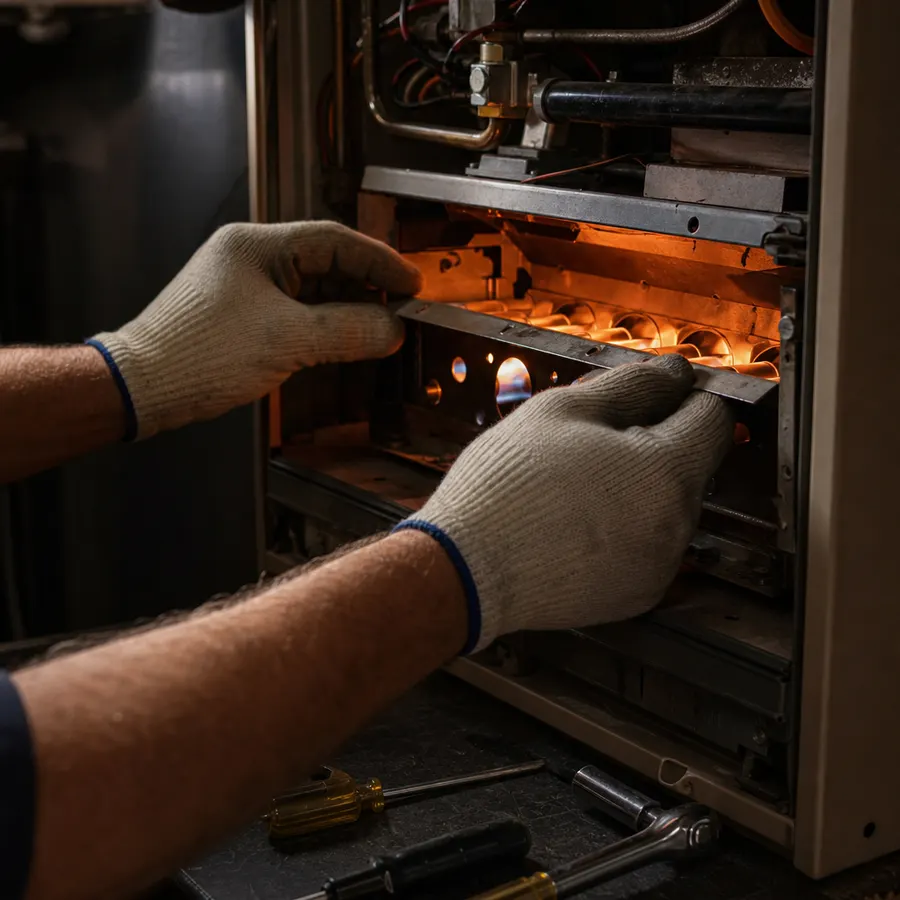
Upgrading or Repairing Your Heating Gas Lines in Berea
Are you trying to install a new high-efficiency gas furnace only to find your existing pipes cannot supply enough fuel, or have you noticed a faint, unsettling sulfur smell near your home's older utility closet? Gas lines are the lifeline of your heating system, and they leave zero room for error, as an undersized line will starve your new equipment while a compromised joint presents an immediate safety hazard. Whether you are retrofitting a historic property or need to safely extend a line for a new heating system, Feistritzer Heating & Air Conditioning provides precise, code-compliant gas line installations and upgrades designed to protect your home.
Signs Your Heating System Needs Gas Line Upgrades or Repair
The Distinct Smell of Sulfur
The most obvious sign of a gas line issue is the smell of rotten eggs near your furnace, water heater, or along the floorboards above a crawlspace. Natural gas and propane are naturally odorless, so utility companies add a chemical called mercaptan to make leaks highly detectable to homeowners. Because this chemical is heavier than air, the smell often pools in low-lying areas like basements or utility closets before circulating through the rest of the house.
This smell indicates that a pipe joint has lost its seal, a valve is failing, or severe corrosion has eaten entirely through the metal. It frequently happens in older homes where rigid pipes have been slowly pulled out of alignment over the years due to structural shifting.
Why You Must Never Ignore Gas Odors
A faint sulfur smell is a critical safety emergency that requires immediate action. Ignoring a gas odor allows combustible fuel to pool in enclosed spaces, creating a severe risk of fire or explosion. Furthermore, breathing in these fumes over time can lead to serious health issues for your family and pets.
If you smell gas, you should never attempt to locate the leak yourself using a lighter or by turning electrical switches on and off. You need a professional to safely shut down the supply, pinpoint the exact location of the breach, and perform the necessary repairs to restore the integrity of the line.
New Heating Equipment Short-Cycling
You might have recently had a new heating system installed, but it turns on, runs for a few minutes, and shuts off before the house actually gets warm. You might also notice the burner flames looking weak, wavering, or burning yellow instead of a crisp, steady blue. While this looks exactly like an equipment failure, it is very often a fuel supply problem hidden within your home's infrastructure.
The existing gas line is likely too small to carry the British Thermal Units required by the new, higher-capacity furnace. When the system demands fuel that the pipe cannot deliver, safety sensors detect the drop in pressure and shut the furnace down to prevent damage.
The Danger of Inadequate Fuel Supply
Running a furnace without adequate gas pressure forces the entire heating system to work much harder than it was designed to. This inadequate pressure leads to incomplete combustion, which creates dangerous soot buildup inside the unit. This soot acts as an insulator, trapping heat where it does not belong.
Over time, this condition will overheat and ultimately destroy the heat exchanger well before its expected lifespan. Upgrading the gas line resolves this bottleneck, ensuring your expensive new equipment receives the precise volume of fuel it needs to operate efficiently and safely.
Visible Rust and Flaking on Exposed Pipes
When you go down into your basement or look into your crawlspace, you might see heavy rust, pitting, or flaking metal on the dark pipes running along the floor joists. Black iron pipes are incredibly durable, but constant exposure to high humidity eventually breaks down the metal. Condensation sits on the surface of the pipes, slowly eating away at the exterior walls over decades.
Once a pipe begins heavily flaking, its structural integrity is severely compromised. Rust acts like a sponge, holding even more moisture against the metal and accelerating the decay process. It is only a matter of time before the weakened metal develops a micro-leak or cracks completely under pressure.
Hissing Sounds Near the Manifold or Shutoff Valve
Even if you do not immediately smell gas, you might hear a faint, continuous hissing or whistling sound when standing near your indoor gas manifold. You might also notice this sound near the shutoff valve located directly behind your furnace. This sound is the physical pressure of the gas escaping through a compromised seal, a failing valve, or a loose threaded connection.
A hissing leak means your system is actively venting a significant volume of fuel directly into your home. It requires immediate professional intervention to shut off the supply, locate the breach with specialized equipment, and replace the failing components before the situation escalates.
Why Berea Homes Require Gas Line Installations and Replacements
Upgrading to Higher-Capacity Heating Systems
Many homeowners are replacing aging, inefficient systems with modern, high-output gas furnaces or advanced dual-fuel systems. However, the original gas lines were only sized for the specific appliances present when the house was originally built. The old half-inch pipes simply cannot carry the volume of gas required by today's robust heating technology.
In Berea, we frequently see mid-century homes where homeowners want to add a gas furnace, a gas fireplace, and a tankless water heater all at once. They quickly find that the main trunk line is severely undersized for the total BTU load, causing all the appliances to underperform when running simultaneously.
Sizing the Trunk Line for Modern Appliances
The solution involves calculating the total fuel demand for the entire home and running a new, properly sized trunk line. We measure the distance from the meter to each appliance to ensure the pressure drop remains within safe operating limits. This guarantees that every piece of equipment receives the exact fuel volume it requires.
To achieve this, we often utilize modern corrugated stainless steel tubing or larger diameter black iron pipe. These upgraded materials provide the necessary capacity while ensuring a safe, leak-free distribution network throughout the property.
Foundation Settling and Joint Stress
Over time, the physical structure of a house naturally shifts and settles into the earth. When the foundation settles, it pulls on the rigid piping strapped to the floor joists, putting immense physical torque on the threaded joints. The heavy clay soils common around the Appalachian foothills expand with moisture and contract during dry spells, accelerating this process.
This constant soil movement causes older Berea homes to settle unevenly over the decades. This gradually warps rigid black iron gas lines until the threads pull apart just enough to lose their airtight seal.
Age-Related Corrosion in Damp Crawlspaces
Metal piping naturally degrades when exposed to moisture over long periods. The protective factory coating on older pipes eventually wears thin, allowing oxidation to take hold on the raw iron beneath. Traditional vented crawlspaces in our region trap high levels of summer humidity, creating the perfect environment for accelerated rust.
For older properties near the college district, decades of damp air circulating around uninsulated black iron pipes inevitably leads to severe pitting. Depending on the extent of the damage, the solution involves cutting out the corroded sections and threading in new pipe, or completely rerouting the gas line using modern, moisture-resistant materials.
What to Expect When We Evaluate Your Gas Lines
Comprehensive Diagnostics and Safety Checks
When you call Feistritzer Heating & Air Conditioning to your home in Berea or the surrounding areas, we approach gas lines with an absolute focus on safety and system lifecycle. We diagnose the whole system, explain the options clearly, and recommend the solution we would choose for our own home. Our first priority is always to secure the environment and protect your property.
Our NATE-certified technicians perform a comprehensive safety check using advanced combustible gas detectors. If a leak is suspected, we perform physical pressure tests to pinpoint the exact location of the drop in pressure. We isolate the compromised section of piping so that the rest of your home can remain safe while we develop a repair strategy.
Transparent Load Calculations and Installation
If you are upgrading your equipment, we perform a rigorous BTU load calculation before installing a single piece of pipe. We measure the capacity of your meter, the length of the pipe run, and the total demand of all gas appliances in the home. We show you the math clearly, explaining exactly why a line might need to be upsized to protect your new investment.
When it is time to install, we use top-tier materials, ensure perfectly threaded joints, and secure every run to strict local building codes. We test the entire system under high pressure before we leave to verify absolute structural integrity. This allows us to deliver a commissioned installation with total post-install accountability.
Comprehensive Heating Solutions for Your Home
Supporting Your Whole Comfort System
Proper gas line sizing goes hand-in-hand with the performance of your equipment. If you are preparing to upgrade your home's comfort system, our Heating Installation & Replacement services ensure that your new furnace is perfectly matched to your home's load and your newly upgraded gas supply. We handle the entire Heating Gas Line Installation process to guarantee seamless integration between your fuel source and your equipment.
Additionally, routine Heating Maintenance & Tune-Up visits are the best way to catch early signs of improper gas pressure or burner issues. If your current system is short-cycling or struggling to maintain temperature, our Heating Repair & Service diagnostics will identify whether the root cause is a mechanical failure or a hidden fuel restriction.
The Real Cost of Ignoring Gas Line Issues
The Immediate Safety Risks of Delaying Repairs
Delaying gas line repairs or trying to cut corners on pipe sizing has immediate and severe consequences for your home. Safety is the most critical factor, as a minor leak does not fix itself and will only grow larger as the pipe continues to corrode or structural stress increases. Allowing combustible gas to accumulate in your home puts your property and your family at extreme risk.
Furthermore, unpermitted or poorly installed gas lines will fail municipal home inspections. This creates major legal and financial hurdles if you ever decide to sell your property, as inspectors will require the entire system to be torn out and brought up to current safety codes.
The Financial Impact on Your Heating Equipment
Financially, under-sizing a gas line is the fastest way to destroy expensive heating equipment. When a furnace is starved for fuel, it burns irregularly and creates excessive soot that heavily coats the heat exchanger. This prevents the furnace from transferring heat into your ductwork properly.
This trapped heat causes the metal of the heat exchanger to overheat, warp, crack, and fail prematurely. What should have been a minor upgrade to your gas piping turns a long-term equipment investment into a costly, immediate replacement.
Secure Your Home's Gas Supply Today
Your gas lines require precision, respect, and expert knowledge to function safely. As a homegrown, family-owned company serving Central Kentucky since 1976, we treat your home's safety with the same accountability we apply to our own. If you suspect a leak, or if you need to upgrade your capacity for a new heating system, the team at Feistritzer Heating & Air Conditioning is ready to deliver a permanent, code-compliant solution in Berea.